
;)
103 years young
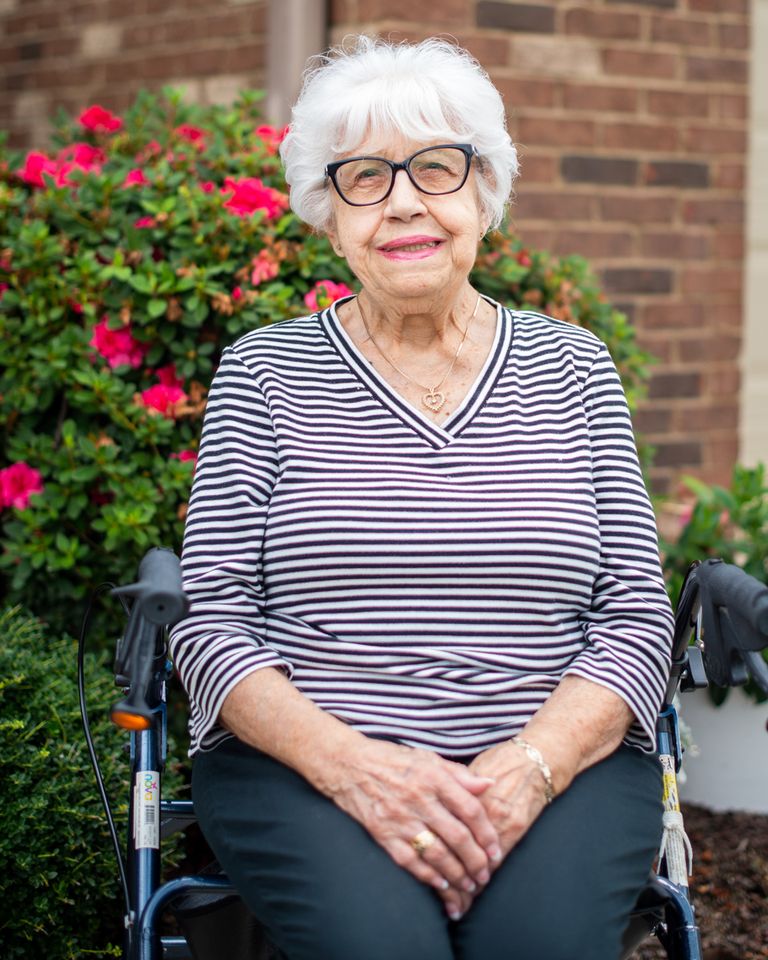
When Lucia D’Addeo Harrison ’42, considers her title as the University of Saint Joseph’s oldest living alumna, she does not dwell on the milestone. “It’s not something I earned,” she says. “It’s just something that God bestowed on me.”

Now 103, Harrison remains as sharp as ever, and her remarkable life reads like a history book. A member of then-Saint Joseph College’s sixth graduating class, she came of age during the Great Depression, earned her degree just as the U.S. entered World War II, and spent a career quietly pioneering new paths in the field of social work. From inspecting B-52 fighter aircrafts at Pratt & Whitney to establishing senior centers before they were commonplace, Harrison has lived a life guided by purpose and powered by progress. When asked if she and her classmates were trailblazers, she laughed, but with a little more thought, admitted the significance of their accomplishments. “In the 1920s, not many women went to college at all,” she said. “So I guess in a way you could say we helped pave the way for the young women who came after us.”
Lucia’s enthusiasm for bridge is only exceeded by her passion for sociology. No mere reformer, she is the champion of the social “under-dog.” Despite the trials and tribulations of a “Soc” major, Lucia has found time to engage in the activities of the Queene’s Companye, the Badminton and Glee Clubs. Lucia’s sincerity is backed up by a good sense of values and the rare ability to criticize without offending.
From the Saint Joseph’s College yearbook
A dream sparked by a graduation gown
Born in Hartford, Conn. in 1922, Harrison was the granddaughter of Italian immigrants and the daughter of parents who deeply believed in the promise of education. At just eight years old, she announced her intention to go to college after attending her favorite aunt’s University of Connecticut commencement in 1930.
Her dream took shape during challenging times. It was 1938, and the Great Depression was still lingering. But Harrison was admitted to Saint Joseph College at the age of 16, supported by a $100 annual scholarship, half of the $200 a year tuition at the time. She commuted to campus as a “day hop,” and committed herself to her studies.
A sophomore Sociology course set her on a path she would follow for decades. “We learned about social legislation, and the history of social work in England,” she recalled. “We also had to do what we called ‘placements’ — which are now called internships.” Her first placement was at the School for Young Children. Later, she was assigned to Hartford’s Union Settlement House, a vibrant hub of services for the city’s immigrant community. It was there that Harrison found her calling. I just saw all these inequities,” she said. “And I thought, ‘I can do something about that.’”
Wartime work, lifelong impact
After graduation, Harrison was admitted into the graduate Social Work program at Western Reserve University in Ohio (now Case Western Reserve University). To pay for it, she took a job at the new Pratt & Whitney plant in East Hartford, Conn. where she was trained as a precision inspector on the small parts used in B-12 engines. She signed up for the night shift and got a half-fellowship, “they paid you for eight hours, but you only worked six and a half,” she said. By the next May, she had saved enough to go to Cleveland.
While pursuing her graduate degree during World War II, Harrison interned at a government housing project for wives and children of deployed soldiers. It was also in Ohio that she met her future husband, Brad, then a senior at Antioch College. The couple married in 1946 and moved to Manhattan, where he attended Columbia Law School and Harrison launched her career.
A life devoted to service
Harrison’s first professional position was at the William Hodson Community Center in New York, the nation’s first-of-its-kind for seniors. She worked closely with the founder, Gertrude Landau, and together they developed programming that offered dignity and social engagement for older adults.
Later, back in Hartford, Harrison applied that experience to help launch a similar center within the Union Settlement House. Her commitment to aging populations continued in Wilmington, Del., where the couple relocated when her husband joined DuPont as a research chemist. There, Harrison again helped establish a senior center — all while raising their growing family.
Eventually, the couple had seven children. Though she took time away from paid work to raise them, Harrison stayed active in civic life, particularly with the American Association of University Women, her chapter being the largest in the country at the time. Its membership included the well-educated wives of the 5,000 PhDs working at DuPont. “It was a great group,” she said. “I made so many friends.” When her children were grown, Harrison re-entered the workforce, serving as a tax examiner for the IRS, and working in the office of the Social Security Administration.
I think the girls today are wonderful. They don’t hesitate to dream big. If they want to be a doctor or a lawyer or a scientist, they do it.
Lucia D’Addeo Harrison
Still curious, still engaged
Now a widow living in Huntsville, Ala. near two of her children, Harrison is as inquisitive as ever. She belongs to a mystery book club, plays Bunko with friends, and never misses the New York Times Magazine crossword puzzle. “I have a mind that never sleeps,” she says with a tone that suggests she is just getting started.
With 10 grandchildren and 12 great grandchildren, Harrison keeps a close eye on the next generation — especially the women. “I don’t remember anybody in my class who wanted to be a lawyer or a doctor. I think a lot of us were in nurturing professions — teaching, or nursing, or social work. I guess we were a sign of our times,” she said. “I think the girls today are wonderful. They don’t hesitate to dream big. If they want to be a doctor or a lawyer or a scientist, they do it.”